This will be held at San Jose State University in California, June 25-27 2014.
The application deadline is April 1. Go to www.instituteforteachersofcolor.org to register.
This will be held at San Jose State University in California, June 25-27 2014.
The application deadline is April 1. Go to www.instituteforteachersofcolor.org to register.
I’m in the midst of commenting on grad students’ lit reviews submitted electronically. This is our online class for the week. Many students profusely thank me for “helping” them. I reply that what I’m doing is teaching.
Of course this is a different paradigm of teaching, one made possible by e-learning. Specifically what I do is use comments to engage the students in conversation with a more knowledgeable other, by which I mean me the professor, MKO in the jargon.
I’m still digesting Walqui & van Lier’s chapters on Vygotsky.
Walqui, A., & Van Lier, L. (2010). Scaffolding the academic success of adolescent English language learners. San Francisco, CA: WestEd.
E-learning has enormous potential if used in this way.

I’ve just started researching the history of CCSS and standards in general because I’ll be teaching a special topics class about them. In the pre-standards days, textbooks determined curriculum. I started teaching high school in the 80’s, and when I asked the department chair what the curriculum for earth science was, he said, "Well you have the textbook, don’t you?"
This mindset, or perhaps you could call it a paradigm, of curriculum being presented to rather than developed by teachers, carried over into the standards era. People expect that they will be told what to teach, even when we have standards that expect teachers to develop their own curriculum.
In this vein, ten years ago when I was teaching a masters-level class in elementary mathematics pedagogy in Los Angeles, I assigned the students to develop a mathematics unit to teach their students about the meaning of the equal sign. The class kind of stared at me. Finally somebody said something very close to: We don’t know how to design lessons any more. All of their lessons were derived from the central office and were completely scripted.
I don’t think state DOE’s and other people in charge of curriculum understand the re-education it will take to use CCSS the way they were intended.
I’ve had a bit of an epiphany in the last few days.
It started when I attended an NSTA regional conference for science teachers. All anyone could talk about was standards, especially Next Generation Science Standards (NGSS). I attended a forum on NGSS and diversity. I left skeptical. The only ones who are likely to benefit are people in the education biz, including professors of education, textbook publishers, and the testing business.
What makes anyone think promulgating new standards is going to fix education? There was a frenzy of discussion of 21st Century skills, globalization, competition, etc. The degree to which education needs fixing is not clear to me, at this point. I don’t think it’s skills. What needs to happen is we need to stop using the educational system to harm kids.
By harm I mean that most people, say 75%, leave high school feeling that they are stupid. Harping on competition and skills is not going to change this. In the 1950’s Talcott Parsons, structuralist sociologist, predicted that increasing requirements in schools would have the unintended consequence of increasing students’ alienation. I believe we are seeing that. Teachers I talk with are tearing their hair out over “unmotivated” students.
Besides, there seems to be a repeat of previous magical thinking: Promulgating standards does not mean anyone is going to change the way they teach.
I am in the education biz to serve children. It’s not to further my career, keep my job, etc. The conference brought me up sharply. What am I doing here?
My intellectual commitments derive from Jean Lave, Courtney Cazden, Fred Erickson, Kris Gutierrez–social practice theory. Linguists such as James Crashen come to the same conclusion from a different angle. Teachers who actually use an alternate definition of learning in their classrooms see students thrive as learners. That makes the scholarly work worthwhile.
How then do we move teachers away from assumptions about learning that create inequality toward an inclusive education for all? I think Rosebery & Warren’s research is a key. They work with small groups of teachers over years to facilitate their understanding of what students are actually doing when they talk about science.
Through the social practice theory lens, teaching is a social practice based on common assumptions of what learning is. My experience is that people don’t like to examine their cultural assumptions, and that the work requires patience and persistence. I’m working on how teachers construct identities, that is, their ideas of what it means to be a teacher, and what sorts of activities support identity change.
The issue of tracking-streaming-leveling, whatever you call it, is a knotty one. One thing we know for pretty much certain is that tracking hurts kids on the bottom. Once a child is placed in the bottom level, it’s almost impossible for them leave it, because opportunity to learn is decreased for the low-track students. I would argue it also hurts high track kids because they get an inflated view of their abilities, reinforcing their sense of privilege. Moreover, it is antidemocratic to provide opportunity to only some (who almost always are upper SES). On the other hand, a multi-leveled classroom requires an entirely different way of teaching, one that provides entry points for students of all prior achievement levels. The vast majority of teachers don’t know how to pull this off, and the result is harmful to high, medium and low students, as well as the teacher. My opinion, based on a lot of observation, is that traditional teacher-centered instruction well done is vastly superior to student-centered teaching of mediocre quality, a situation in which nobody seems to learn much of anything. In other words, I think reform pedagogies are more sensitive to the skill of the teacher. I seem in my posts to come back time and again for the need to transform teaching.
Education in the US, and in the countries which use European-derived systems of schooling, are based on the assumption that knowledge is an acquisition of information by individuals. We believe it is "natural" that some students learn better than others. Our entire education system is based on this belief. We develop standardized tests and have a multi-billion dollar industry based on this premise. However, in almost all learning situations outside of school, people learn new ideas and new skills through participating in the milieu in which they find themselves. For example, Mayan girls sit beside their mothers as they weave, help as they can, and over time begin to make their own weavings. No one "teaches" them. They learn through participating in village life. (This is documented by theorist Barbara Rogoff. Her book, The Cultural Nature of Human Development, is well worth reading.) Studies of non-school learning repeatedly show that teaching is not required for learning. Rogoff defines learning as "transformation of participation." In fact, all children who are not neurologically compromised accomplish the incredibly complex task of learning their mother tongue through their participation in family and community life, and do so without explicit teaching. How then, can we design educational institutions in which students are engaged in tasks where they can increase their competence? What sort of STEM tasks can children do that allow them to participate at more and more complex levels?
As far as transforming teaching, we need first to acknowledge the harm that the current view of learning causes. We also need to recognize that our assumptions about learning, when we investigate them, are simply not valid. Teachers need tools to understand the cognitive skills which each student brings to a classroom. They need to understand that ALL children are attempting to make sense of the schooling they receive. In this vein, I recommend Warren & Rosebery’s work. If you don’t know it, their edited book, Teaching Science to English Language Learners, is the result of many years of working with teachers to overcome deficit views of some students.
All of what I write here will be bullshit. Still, I’m going to write it. It seems the Divine Shakti has inspired it. This is no claim to be special, since anything anyone does is through the inspiration of the Divine Shakti. In fact, I’m told by my teacher that anything anyone does is an illusion and that everything is the action of Shakti, that there are no persons in reality.
The words of the scriptures, gurus and teachers tell me I’m not doing anything, and in fact that there is no me. The me often finds herself in a confused state, since she knows there is no me and yet doesn’t she know what else to do, if that is comprehensible at all. The problem is the “doing.” There is no doer and nothing is done. Oh crap.
Reasoning will not get anywhere, as the above paragraph shows. I understand there is no point in trying to figure it out. Only fear holds me back. I ignore it as I am able and strike out for the other shore. Gone, gone, gone beyond.
I have always been here and now. Nisargadatta Maharaj says to investigate the I am.
The me recently went through a period of intense spiritual practice, japa, contemplation, and for now that is over. I bow to all the gurus, teachers and realized beings who are the Self as I am the Self. Namaste.
Click here to get a PDF of the paper.
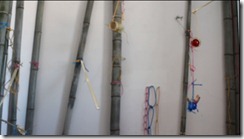
Well, it was frustrating because I didn’t have the right camera. The best shots are slightly out of focus. I used them anyway, especially the red sphere shots. They give me the feeling I didn’t know I was hoping for. Funny because I wasn’t really going for beauty with the installation, or expecting it. I find unexpected beauty that catches my mind off guard seems to bring a more open state of consciousness.
Is there another word for beauty? Anyway all words are inadequate.