All posts by Vickie

video

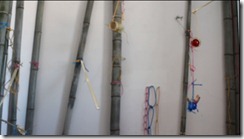
Well, it was frustrating because I didn’t have the right camera. The best shots are slightly out of focus. I used them anyway, especially the red sphere shots. They give me the feeling I didn’t know I was hoping for. Funny because I wasn’t really going for beauty with the installation, or expecting it. I find unexpected beauty that catches my mind off guard seems to bring a more open state of consciousness.

Is there another word for beauty? Anyway all words are inadequate.


Capture

Student-Led Test Prep Lesson Plan

I’m attaching a lesson plan I wrote for a student teacher to think about. It’s a procedure I used with high school science students. This is my response to the paradox of trying to prepare students for standardized tests in ways that are consistent with what we know about how students learn.

Please click here to see the lesson.

Why STEM Education?

I keep coming back to some fundamental questions:

What kind of world do we want to live in?

Are we taking the steps to create the world we want?

What is the role of STEM education in a world of 7 billion people (and growing).

In my opinion, without advance of technology and increase in scientific literacy amongst the general population, the future for the 7 billion will be unfortunate. There are some who predict the “end times” and welcome pestilence, famine and destruction as God’s will. Surely the God of mercy and love such people espouse does not wish such suffering upon his children.

The fascination with the end of the world is baffling to me. How many times has it been foretold? In 1995 I asked my high school students what they thought the world would be like in 20 years. “The world’s going to end in 2000,” someone replied. “How do you know?” I said. A chorus responded, “We saw it on Fox!” I said, “We’ll see.”

The STEM disciplines require evidence for claims, at least that is the ideal. People who are trained to draw conclusions based on observable information are less likely to be swayed by emotional, fear-based notions such as the call to arm elementary school teachers. Carrying a gun may make some people (not me) feel safe, but the data is clear that the more guns, the more deaths. When people are able to objectively judge the merits of claims, they are likely to make better decisions.

In America we have come to the cultural understanding that everyone is entitled to his/her opinion. Paradoxically, however, we must continue to consider that not all opinions are equally supported by evidence, and therefore not all opinions are equally valid. Increasing people’s ability to critically evaluate evidence is crucial for the future of the United States and the world.

In my opinion, the only way out of the troubles caused by industrialization, overpopulation, burning of fossil fuels, destruction of Earth’s life support system, etc. is to move forward with technology. We need to know more and do more with technology so that we can have a world we want to live in.

Youth are telling us something important

I had occasion to overhear a conversation among some college students. Some sorority girl types were chatting before class. Said one, “I was walking down the hall and Ashley smiled at me. I didn’t smile back. I don’t like her.”

My own daughter, now age 23, told me similar stories of people ignoring her in high school when she said hi to them. I didn’t necessarily believe her. Surely there is some tiny bit of civility among young people. And these are college kids, not teenagers.

It seems to me the issue is not seeing value in those who are not like you, and I would venture to guess, being fearful of those who don’t follow social norms. I don’t know what Ashley did to incur such petty rudeness. I don’t think anyone deserves to be treated that way. In the long run, the sorority girls lose out, since they don’t get to meet a lot of people who might enrich their narrow experience.

All of us lose out though. We have groups of people in America who see no reason to interact with those who are different. It leads to the kind of polarization we see in our politics. The sorority girls become soccer moms, send their kids to private school so they don’t have to mix with those people, and vote no on public transportation, because they would never put themselves in a subway car with those people.

The important thing the sorority girls are telling us is that they have very poor social skills, and little interest in acquiring them. Imagine being a gawky nerd in a high school dominated by these creatures. We wonder why angry young men barely holding it together mentally might take a Bushmaster and start shooting at those who torture them, or even worse, murder the innocent first graders who who represent hope for the future.

We could be working with young people in schools so they develop trust, tolerance of difference, and the ability to communicate across ethnic and social divides. But no, the mania for testing and accountability has led us to ruthlessly sort out the winners from the losers, and discard those who don’t reach academic or social targets. They become test scores rather than human beings.

The problem with treating people as objects is that it damages them. It is not any way to create a society we want to live in.

Why do we have school?

Not for education. At least not for education in reading, thinking, problem solving and reading the world with numbers. As far as I can see, school is for learning to stand in line, coping with incredible boredom, competing with others, sitting still, dealing with being the best or not being the best, and developing subterfuges for avoiding or attracting the attention of authority figures.

As I visit classrooms, I see that much less than half, much less than a quarter, of the “instructional” time involves engagement with ideas. Enormous effort is expended in coercing students to sit silently in desks. Students are not allowed to go to the bathroom by themselves—the teacher must take the entire class at a scheduled time, stand in the hall monitoring and enforcing silence, which students quickly become adept at resisting. This procedure takes 15-20 minutes, and makes the teacher not a professional educator but a babysitter. Then the entire class must walk back into the classroom, settle back down, and resume whatever rote task they were engaged in.

Announcements, very loud announcements, regularly interrupt instruction. I watch teacher after teacher stand silent for 2-3 minutes while the office makes some announcement about bus schedules, or asks for so-and-so (student) to please come  to the office for some reason or other. I’ve rarely spent a half hour in a classroom that was not interrupted, usually two or three times.

There is no recess, students are not allowed unstructured time to work out social relationships or develop social skills, or develop the sense of self-efficacy that comes with them. There is very little physical education as we concentrate on basics.

So what are students learning? On the plus side, there’s nothing wrong with developing self-control. On the minus side, to be monitored, to quietly resist authority, to deal with boredom. Most students learn that a few kids are very smart but they are not. This smartness remains mysterious to those who are not.  Is it surprising that kids are alienated, smoke pot, drink themselves into a stupor during high school, play video games endlessly and…take assault weapons to school and shoot the place up?

“Experimental” schools consistently demonstrate that children and youth can do so very much. These schools can no longer be called experiments—we know they foster engaged, literate and energized citizenry. I am left with the conclusion that the condition of education is intentional.

Murder and Education

Thinking about the murders in CT. Watching the news–interview with a psychologist, who talked about how "these guys" are always isolated, and blame others for their troubles. Also I note that the kindergarten-teacher mother was really into the gun collecting and shooting. I see a connection, not the obvious one. Troubled people have always been with us. But now troubled people live in a gun culture, where they are easily available and just a normal part of life. 300 million guns in America have not made us safer.

It’s easy to demonize the perpetrator. That’s exactly what he did: demonize us.

Why do we think it’s normal that a kindergarten teacher would be a weapons aficionado? Personally I think there’s something dark here. And I’m not blaming anyone. It’s just very odd.

Years ago when I was in graduate school, I dated a fellow from East Africa. He had been born in a small village high on the slopes of Mount Kilimanjaro and had somehow found his way to a PhD program at UCLA. He told me the story of how he had walked in to a Wild Western-theme bar in Westwood, where they had cutesy signs, “Check your weapons at the bar.” He told me how terrified he had been that people might be walking around Westwood with handguns, and ran out. Raised in the wilds of Africa, he found such an idea unspeakably uncivilized. This was in the 1970’s and probably most of were not carrying handguns in our purses. It wasn’t socially acceptable yet.

Who is responsible for this fierce aggressiveness that is all about us?

Co-Teaching Physical Science for Teachers

Last night Rosalie facilitated a lecture-discussion on heat, developing students’ ideas about energy transfer and how to do problems. I noticed a couple of times students gave the "right" answer, but when Rosalie probed further, the students didn’t really understand what they were talking about. It would have been easy to accept the correct answer as proof of understanding and then move on. The extent of students’ not knowing was profound, and it took some time to uncover its true dimensions.

I’m reminded of diSessa’s construct of p-prims, which he describes (to the best of my recollection) as conclusions about phenomena which are not linked to other ideas, but remain as islands. When Rosalie asked students to make connections or to create a chain of causal reasoning, they were able to do so only with great difficulty and a great deal of prompting in the form of questions. She engaged individual students in extended questioning in order to scaffold putting together a cohesive whole.

I noticed that not all students were following the conversation and did not seem to understand that their colleagues’ were being questioned publicly in this way in order to get ideas onto the table for everyone to consider. Earlier in the evening students repeatedly focused on the right answer, and when someone came up with an answer that was judged to be correct, it was quickly passed around. At the time Rosalie announced that we were not really interested in the correct answer, which the students seemed to shrug off. I think that they don’t have any other perspective on science calculations, and the idea of viewing problems as a shorthand for science concepts is an entirely new idea for them.

At the end of Rosalie’s discussion of heat, I felt that we should call students’ attention to what we had been doing by investigating their ideas in depth. I had two purposes in doing this. One was to let students know that the structure of our lesson was deliberate, and that we had a particular pedagogical goal in mind. I also wanted to clue in those students who had not been paying attention that perhaps this was important. I reiterated that we were not interested in formulas, but that they should focus on understanding the problem; understanding makes the strategies for solving it obvious. Rosalie reiterated that she too is not interested in students memorizing formulas. I also explained that there had been several times during the lecture when students had appeared to give the correct answer, but Dr. Richards kept probing, and it was revealed that the students did not really understand. I tied this to the issue of deciding what to accept as evidence of learning, and asked whether they had run into this phenomenon in their field placements.

I will say that we started the evening with a wide ranging discussion of the role of energy in the body, and the way chemical energy of food is transferred through digestion and metabolism. I was expecting students would not relate the process of combustion from the lab of calories obtained by burning Cheetos with the breaking of chemical bonds within food substances. I discovered this some years ago in teaching high schoolers, when I would ask them why they need oxygen, and the students were unable to go beyond because you can’t breathe and you’ll die. What a shame it is that we don’t explore the big picture and assume that students have made connections such as the role of oxygen in both combustion and cellular respiration.

The conversation about heat contained within food revealed that students remember very little of any high school biology.

The previous night in one of my graduate classes we started exploring the idea of their perceived lack of connection between learning and completing assignments. Before Rosalie came in, I decided to see what the undergrads had to say about this topic. They basically said they had to choose: either do the assignment and get the points, or study and try to understand. I wondered whether the purpose of doing assignments is to facilitate learning.

We did not get very "far" in our discussion of heat, although we perhaps got deep. I came away from last night’s class with another piece of evidence I interpret as showing the need to explore ideas in depth, and the conviction that most science instruction merely papers over students’ confusion.

“Seeing” forces

This lesson was developed in a Lesson Study Project over three years. The authors are Karen Vanderheyden, Markeeta Clayton, Nikki Grimes and John Graybill. They called this lesson–

“Send in the Reinforcements” You can download it here.

The lesson is the first in a series of explorations of the way members and joints distribute load in a bridge. The original idea came from a video on the Annenberg Foundation learner.org, which I highly recommend. We have been unable to locate the video clip of the original activity, although hopefully it is still there.

The beauty of this activity is that it allows students to “see” force vectors, at least their direction. Magnitude is represented by the thickness of the paper which transmits the force.

Jet Straw Lesson on Newton’s Third Law

Jet Straw

Victoria Deneroff, PhD

I stole this idea many years ago from the NASA website, although I have adapted it to be an engineering challenge rather than a science activity. The original appears to no longer be easily available on the web.

Design Challenge

Build a jet straw air engine which produces the highest rotational speed.

What is a Jet Straw?

The jet straw is a simple engine that is powered by air released from a balloon. It is a system consisting of a balloon, bendable straw, rubber band, straight pin and pencil eraser. The straight pin is used as a pivot point around which the system rotates.

Beginning Ideas

In your journal write down what you think is the best way to construct a jet straw engine.

Stage 1: Messing Around and Asking Questions

Use the rubber band to attach the balloon to the straw so that it will rotate around a pivot point. Use your journal to record the different ways you tried to make the engine, and what you finally tried that worked. Brainstorm questions that will help you make a jet straw which rotates more quickly. Make a list of the questions, and in pairs decide on one to investigate.

Stage 2: Tests and Experiments

Decide how you are going to find the answer to your question by conducting an experiment. Each person should write down the step-by-step directions for conducting the experiment. The procedure must provide a way for you to collect quantitative data by taking measurements. What these measurements might be is up to your team. Consult with the teacher when you think you have a good procedure.

Stage 3: Observations and Measurements

Record your observations and measurements in your journal. As a class we will discuss your observations and what they mean.

Stage 4: Claims

What do you claim is the best way to design a jet straw engine, based on your tests? Write in your journal

Stage 5: Evidence

In your journal, explain how you know this is the best way.

Stage 6: Prepare a poster which explains

A. What your question is.

B. What your findings are.

C. The scientific explanation for your findings

D. What your recommendations are for others who want to build a jet straw engine.

E. We will discuss all the findings as a class.

Stage 7: Reflection

Reread your original questions. How have your original ideas changed, or grown? What do you wonder about now?

Stage 8: Redesign.

With your partner, revise your jet straw engine design, making a sketch of it in your journal. Build your revised design and record how it works.